
As the climate warms, precipitation is falling more often as rain and less often as snow. How does this affect groundwater recharge?
This was the question asked by researchers JT Reager, Noah Molotch, and Jay Famiglietti in their new paper, Net Groundwater Recharge in California Occurs Primarily During Above-Average Snowpack Years. Using data from NASA’s GRACE and GRACE-On satellite missions, which track changes in water storage, the authors studied the impact of California’s heavy winter snow in the 2023 water year on groundwater recharge. They calculated groundwater storage as the total water storage minus the snow water equivalent, the surface water, and the soil moisture:
GWS = TWS – SWE – SW – SM
They then took the change in groundwater storage per month, or the derivative, to identify periods of recharge and depletion and compare them to winter precipitation. They found the following results:
First, net groundwater recharge per month peaked three months after the peak in overall terrestrial water storage in WY2023, confirming the delayed precipitation-infiltration-recharge processes at hand. Next, in the six years with positive recharge, albeit a limited sample size, SWE tended to be a much stronger indicator of groundwater recharge than overall precipitation as liquid and snow. This was especially seen when contrasting WY2023 with WY2006. 2006 had more precipitation but half as much snow as 2023, and this was reflected in the recharge rates: 2006 had only 0.26 cm per month, while 2023 had 1.18 cm per month, indicating the importance of snow in groundwater recharge. The researchers aptly point out the small sample size, though these results are telling of the relationship between snowmelt, the delaying of streamflow into spring and summer, and the increase in groundwater recharge.
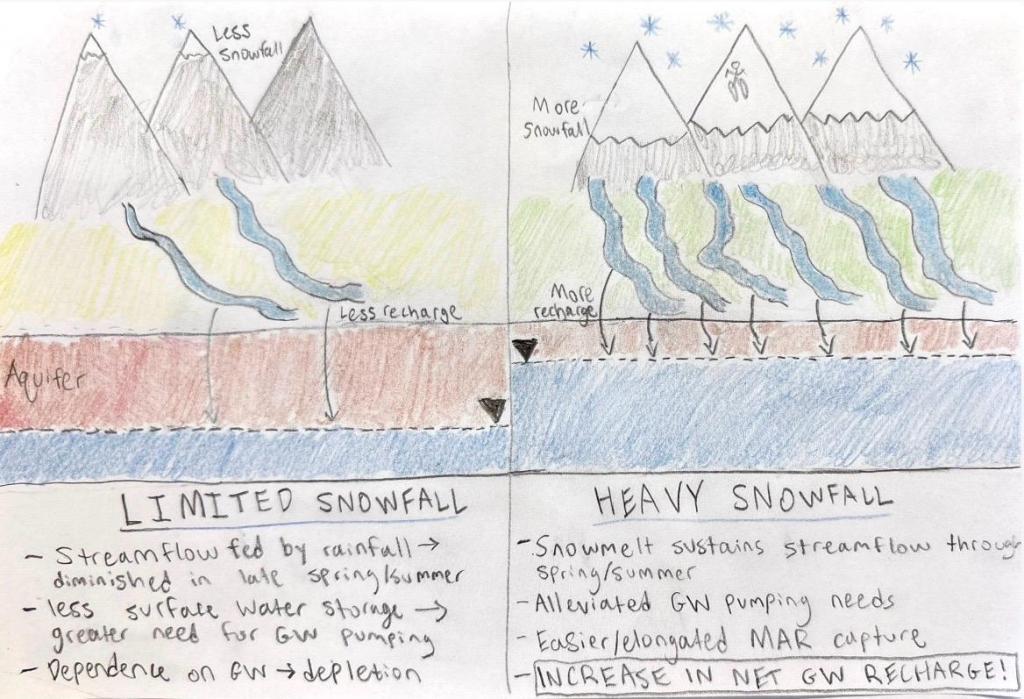
While many processes are at hand, these results detail the importance of snowmelt as an “enabler” for groundwater recharge. This is because it not only leads to significant recharge, but it also increases surface water storage, alleviates pumping needs, and enhances MAR capture.
Another consideration is the future (and current) effect of climate change on snowpack. Warming climates in California will lead to a lower percentage of precipitation being snowfall. If snowfall is such a strong indicator of recharge as is detailed in the paper, then it is going to get much more difficult to recharge California’s already-depleted groundwater reserves.
One last note with relevance to the almost surely coming El Niño: according to the paper, the WY2023 groundwater recharge only amounted to 40% of the year’s total water storage change and ten percent of the total precipitation that entered the system. While it is still a large number, significant deficits remain in terms of capturing this precipitation and replenishing our depleted aquifers. Reservoirs will be filled this coming winter, but aquifers and their much larger capacity to store excess water will determine the boost to California’s water resiliency. They just may not recharge themselves, especially if a larger proportion is falling as rainfall.
Great work by the researchers combining a simple water balance, modern technology, and hydrological ingenuity to add new insights to a critical aspect of the water cycle. Check out their work, including some great graphs:
Leave a Reply