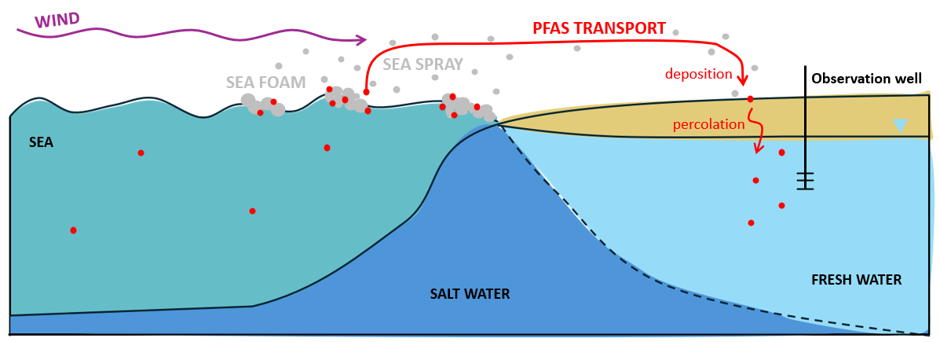
PFAS are, currently banned or restricted, human-made “forever chemicals” used in products like non-stick pans, waterproof clothing, and firefighting foams. These contaminants are widely known for absorbing to air/water interfaces, for example, they tend to accumulate in aerosols derived from sea spray (tiny particles released by wave brakes and wind) that may reach coastal land before deposition. After deposition, PFAS will make it to groundwater by percolation through the soil and they may pollute it to a level above drinking water limit.

GEUS-DK recently published an analysis of PFAS in Danish groundwater and something that sparked our curiosity is that the concentration of PFAS was higher in the coastal wells near the North Sea than the Baltic Sea. Is it that the North Sea is more contaminated than the Baltic Sea? The answer is likely no, since the PFAS concentration in both seas is known to be of the same magnitude.
Then, why is this happening?
The authors discussed some possible reasons
- Less wave energy leads to less preconcentration of PFAS in seafoam
- Predominant wind direction favours North Sea sea spray inland
- Geology and land use of the coastal area
Can you come up with any other reason?
Albers, C. N., & Voutchkova, D. (2025). Sea spray aerosols can be a source of PFAS pollution in coastal aquifers. Environmental Science: Advances, 4(12), 2069–2078. https://doi.org/10.1039/d5va00181a

Leave a Reply